

Design Thinking, the path towards innovation
30, NovemberA report developed by Dinero and SAP, explains how the Design Thinking Mindset is becoming the key to innovate in different companies all around the world. The ...
By David Kaplan* Ever since I have been studying labor markets in developing countries, a question that arises is: ...
By David Kaplan*
Ever since I have been studying labor markets in developing countries, a question that arises is: why is labor informality so stubbornly high in Latin America? Is it an incurable disease? Is it due to structural problems or because of some sort of secret curse against the region? I have recently wondered whether part of the problem may be generated by aspects such as the quality of the Rule of Law. And, therefore, I decided to compare some numbers.
To make a first approach to the relationship between labor (in) formality and Rule of Law, I used the World Justice Project as reference, which four elements to define and asses the Rule of Law. The wealthiest countries tend to have better Rule of Law levels, at least according to the World Justice Project. Wealthy countries also tend to have largest shares of workers in formality. But, is there a relationship between the Rule of Law and formal employment, even considering countries’ wealth?
The following graphic matches data from the Information System of Labor Markets and Social Security (SIMS), using databases of the World Justice Project. The vertical axis shows a measure of labor formality: formal workers (with social security) as a share of the total number of workers. And the horizontal axis represents the coalification of the Rule of Law. The two variables are adjusted by the GDP per capita of the country, in such a way that positive values indicate that the variable has a greater value than expected, considering the country’s wealth. The interesting fact is that, even considering the GDP per capita of every country, there is a close and positive statistical relationship between the indicator of the Rule of Law and the share of formal workers. In other words: deducting the wealth factor per country, the greater the respect to the Rule of Law is, the larger the share of labor formality is.
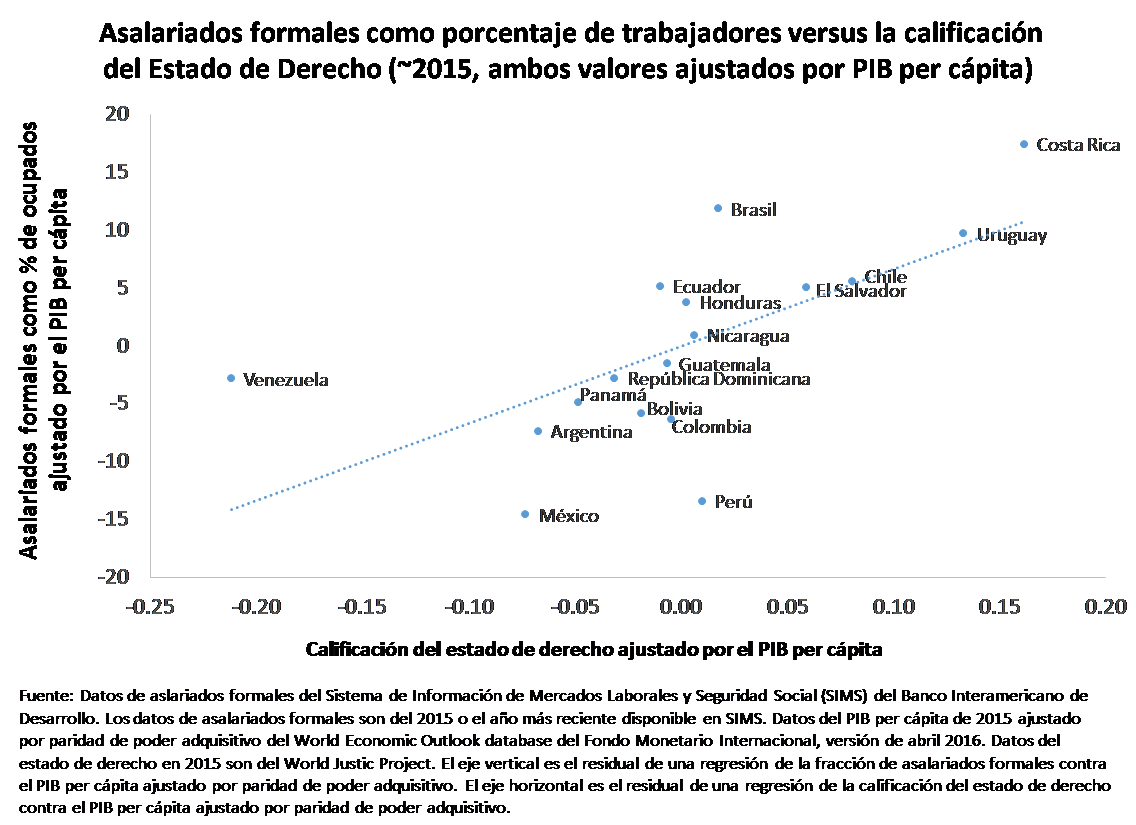
Considering that there may be a correlation between Rule of Law and formality, I came up with new questions. What would the impact of a complete Rule of Law be on a labor market? To begin with, clear rules and limitations to the power of governments could promote contractual relationships that are traditionally under the surveillance of the government. Provided that salaried jobs, particularly formal jobs, are strongly regulated and inspected, a complete Rule of Law could promote formal employment. In addition, in several cases formality is the result of employers’ compliance. If the government can enhance law enforcement, greater levels of formality can be expected among employees. In both cases, it is expected that a full Rule of Law could lead to a larger share of formal workers.
The quality of the Rule of Law also depends on the “democratic quality” of a country in every level (including public institutions, individuals, enterprises, associations, etc.). Democratic quality is measured in terms of how a culture admits or rejects certain attitudes and behaviors. Do we tolerate that an employer may try to save money by hiring a worker under informal conditions? Do we accept bribes as a normal situation? Do we try to pay less taxes and justify ourselves by saying that “everybody else does it”?
Labor informality is a serious problem for Latin America and the Caribbean. Not only because of the lack of protection it entails, but also, as we explained in Jobs to Grow, because informality generates a vicious circle that traps millions of workers (over half of the workers in our region!) in labor precariousness.
There are many explanations for the high labor informality rates in the region. The lack of human capital is one of them. Labor costs (excluding salary), labor legislation products, social security contributions, and the tax system, are others. My intention with this text was to state that, possibly, labor informality is a symptom of a more serious illness. The lack of a complete Rule of Law might explain high informality rates in certain countries, even though I do know that empirical basis for this hypothesis is not conclusive. However, should the hypothesis be confirmed, it might explain the surprisingly persistence of labor informality in certain countries.
*David Kaplan is a senior labor market specialist in the Labor Markets and Social Security Unit of the Inter-American Development Bank (IDB)
Source: IDB – Factor Trabajo.