

As AI changes staffing, this single word could be the key to success
30, SeptemberScott Wenger Staffing firms need to make adaptability an organizational priority as artificial intelligence reshapes their capacity, clients’ expectations and ...
By Horacio De Martini * for staffingamericalatina After having travelled around the world for many years, and being ...
By Horacio De Martini * for staffingamericalatina
After having travelled around the world for many years, and being closely connected to the Labour World, I have come to confirm that the “divorce” between the need companies have for qualified workers and the creation of such workforce through different dimensions of the educational world, still is a pending issue.
Clearly, countries that do not generate updated workforce run the risk of becoming less attractive to potential investors.
Governments may offer different types of advantages to attract investors. And investors may enter a country providing not only financial resources but also technologically advanced tools.
If the country does not have an adequate workforce to manage these tools, it will be facing serious difficulties. This is actually a fact for every kind of investment: those arriving at a country and those already located in; those that expand and must modernize their management technology.
It is a global issue that is quite evident everywhere and that worsens every day due to labour systems becoming more sophisticated and the delay in the development of the professional resources who manage those systems.
A study conducted this year by ManpowerGroup about the difficulties companies face when filling job vacancies with qualified professionals, shows the percentage of executives who express their concerns regarding this difficulty.
The five top countries are the following: Japan 83 %, Peru 68%, Hong Kong 65%, Brazil 61% and Rumania 61 %.
It is important to highlight that in Latin America, 68% of Peruvian businessmen have difficulties accessing qualified resources. Furthermore, 61% of their Brazilian colleagues face the same problem.
If we focus in Latin America we can see that whenever a country develops an expansion process or approves a major infrastructure program (highways, airports, sports’ events, etc.), it stumbles with a shortage of qualified staff.
In other countries within the region, businessmen state their levels of difficulties as follows: Mexico 54%, Colombia 47%, Costa Rica 46%, Panama 46%, Guatemala 44% and Argentina 37 %.
Multiple causes lead to this phenomenon. I shall try to explain such causes in a few words:
When we analyse which are the positions that are most difficult to fill in the World (Global Column) and in Latin America, we come up with the following ranking:
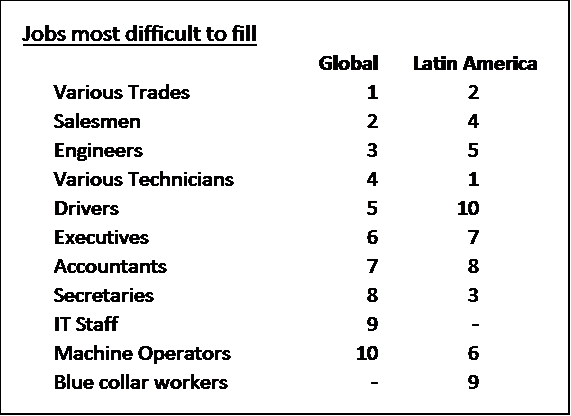
Even though there are a few differences regarding the order, these ten positions are similar in both cases. This kind of analysis must force us to consider the way we should train our youngsters so that they become a strategic element of our countries’ development.
This issue directly involves several social actors: Governments, Training Entities (Schools and Universities) and parents. Parents’ opinions and guidance play a major role in the decisions their kids make regarding the course of study they want to follow. It has been confirmed that many students access degrees they know very little about. Their frustration when they go out into the labour market and have difficulties finding a job is quite significant. In other cases, many graduates who do actually get a job in their area of studies find out that they are not satisfied with it or that it does not match the idea they had about their career.
For all these reasons I believe it is essential to focus on the evidence that shows that successful countries are those which have the best Human Resources.
* President Manpower Group South America (1976-2011)
President CIETT (2008-2011)
Senior Avisor staffingamericalatina