

Design Thinking, the path towards innovation
30, NovemberA report developed by Dinero and SAP, explains how the Design Thinking Mindset is becoming the key to innovate in different companies all around the world. The ...
By Angel Melguizo Angel Melguizo is Coordinator of Pensions and en Expert Leader in the Unit of Labour Markets and ...
Angel Melguizo is Coordinator of Pensions and en Expert Leader in the Unit of Labour Markets and Social Security in the Interamerican Bank of Development (IBD). Before joining the IBD, he worked as Economist in the Latin American Unit in the OECD, contributing to the publishment of “Economic Perspectives to Latin America”. Before, had been advisor in the Economic Office of the President of the Spanish Government and Principal Economist in the Service of Studies at BBVA. He is an expert in the analysis of reformation of pensions in Latin America, Tax Policy and Economic Growth. His research interests involve Latin America development, tax policy and pensions. He has doctorate in Public Economy and a Master´s degree in Economy given by Complutense University of Madrid.
The problem of labour informality does not only involve Latin America and the Caribbean.
Most part of the labour force in Asia is also informal, according to the report “Pension at a glance in Asia Pacific1”, which OECD has recently published, comparing the pension systems of the main economies of the region of Asia Pacific, included China, Japan, India and Southwest of Asia.
On average, only 4 out 10 workers in Asia are formal, the percentage that we have in our region. That is to say, except for some countries which have high incomes such as Japan, Singapore or South Korea, labor informality is a share challenge (see Graph 1)
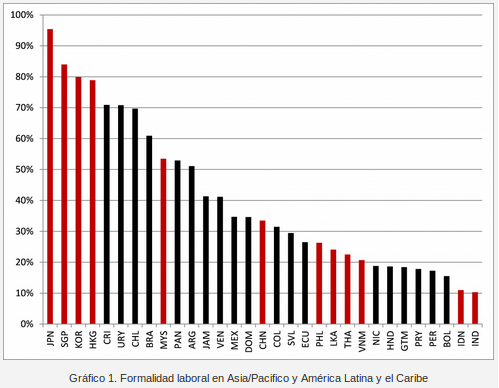
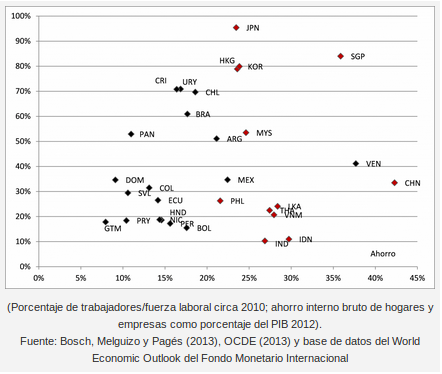
In Latin America and the Caribbean, these high levels of labour informality are evident not only among the workers who have a low income, but also among those who belong to the emerging middle class (Better Pensions, Better Jobs2) and they mean, except for Venezuela, very low levels of private saving (homes and companies)
Due to the lack of reformations, this situation will put at risk the remarkable advances in the reduction of inequality and poverty.
All this, advices both regions to share agendas about policies which can contribute to fight against labour informality. In this area, the spectacular advances made by South Korea when it comes to labour and macroeconomic matters are one of the most clear examples.
On the other hand, the Asia Pacific economies compensate these high levels of informality (that is to say, low levels of formal provisional saving) with the highest private saving rates in the world.
As we can see in Graph 2, almost all the countries of Asia Pacific (marked in red) show levels of gross domestic saving which are superior to the ones of Latin America and the Caribbean (12% more as a difference of simple averages)
All this, advises both regions to share agendas which can contribute to fight against labour informality. In this area, the spectacular advances made by South Korea when it comes to labour and macroeconomic matters, are ones of the clearest examples. Besides, it would be interesting to evaluate what can be learned from the Asiatic experience (even Venezuela´s) about how to boost saving apart from considering labour and pensional policies.